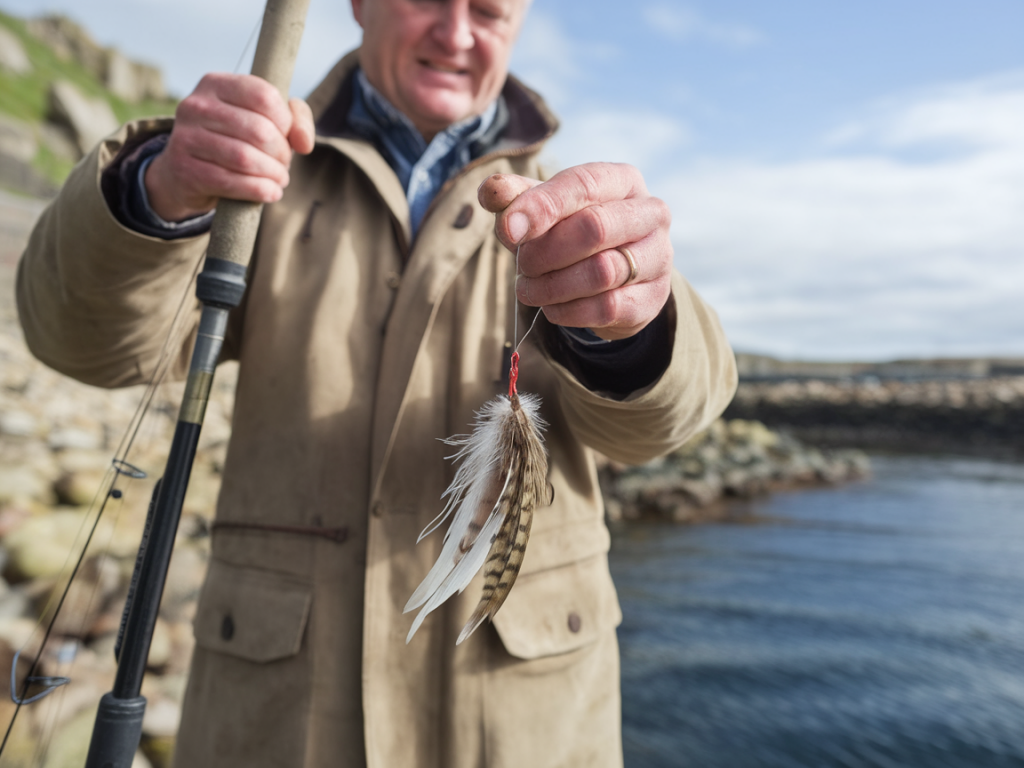
I’ve spent more early mornings than I can count sitting on slick rocks in Welsh harbours, watching sleek mackerel blitz the surface and nicking my lures before the pollack even show interest. Over the years I’ve developed a feathered teaser rig that does two things: frustrates the mackerel thieves and tempts pollack out from the kelp and behind boulders. Below I’ll walk you through the materials I use, step-by-step rigging, how I fish it from the shore or a low-tide jetty, and the tweaks that make it shine in our local, rocky Welsh waters.
Why a feathered teaser?
Feathered teasers work on a couple of behavioural cues. Mackerel are visual predators that often go straight for flashy, rapidly-moving targets near the surface — they’ll take a lure or a teaser and sprint away with it. Pollack, by contrast, are ambush predators that react to a more natural silhouette and a twitching, erratic presentation beneath the surface. A feathered teaser gives you both: a surface/near-surface attractor that keeps mackerel busy and a subtle, trailing teaser that reads like a wounded baitfish to pollack.
What I carry in my kit
| Item | Purpose |
|---|---|
| 9–12ft fixed-spool rod (peeler or distance shore rod) | Long enough for harbour casts and to control fish near rocks |
| 4000–5000 reel spooled with 15–20lb braid (or 20–30lb depending on structure) | Low stretch for feel and a strong backbone for rock fights |
| 20–30lb fluorocarbon leader, 2–4m | Abrasion resistance and invisibility in clear harbour water |
| Feathered teaser (hand-tied or commercial like Izumi/Black Pepper style) | Attractor in the top 1.5–3m of water column |
| Striped or sandeel-style lure (80–120mm) or a soft plastic on a jig head | Main lure to trigger pollack beneath the teaser |
| Sliding or fixed dropper loop / side-trace ring | To present teaser ahead of main lure |
| Small split-shots / sliding sinker (10–30g) | Adjust teaser depth and keep lure near kelp lines |
| Strong size 1–4 trebles (for feather) and 1/0–3/0 single hooks (for lure) | Quick hookups and secure holds |
How I tie the rig
I like a simple two-lure arrangement where the feathered teaser rides ahead of the main lure on a short trace. Here’s my go-to setup — adapt lengths and hook sizes to local conditions.
- Start with your braid mainline and tie a secure loop-to-loop or swivel connection to a 2–4m fluorocarbon leader. I use a double uni or FG knot if I'm feeling particular about low bulk.
- At the leader’s end I create a small dropper loop about 60–90cm from the butt end. That dropper loop carries the feathered teaser trace. The main lure goes off the leader’s tag end.
- For the feather trace I use 30–40cm of 20–30lb fluorocarbon with a small swivel and a size 1–4 treble tied on the end holding the feather. If you’re handtying the feather strip, secure it with epoxy or thread at the shank and finish neatly. Commercial teasers with silicone skirts also work—Izumi and Yamashita make tidy patterns.
- The main lure gets a 60–100cm trace of 20–30lb FC depending on how deep I want it. I favour a slightly longer main trace when fishing deeper kelp edges (around 80–100cm) and shorter (60cm) when the shelf is shallow.
- Add a small split shot or 15–30g sliding sinker above the dropper loop if you need to bite into current or push the entire rig slightly deeper. Too much weight ruins the teaser action — start light and build weight only if the teaser rides too high.
Rig diagram (text)
Mainline (braid) —> connection knot —> Leader (2–4m FC)
At 60–90cm from leader end: dropper loop with feathered trace (30–40cm FC + treble)
Leader end: main trace (60–100cm FC) + main lure (single hook/soft jig)
How I fish it from rocky harbours
The trick is presentation and patience. I cast parallel to the kelpline or slightly upcurrent of rocky pinnacles and let the rig settle. Your feathered teaser should sit in the upper metre or two — visible enough to attract mackerel but not so shallow it reads as a surface pop. Then I use a twitch-and-pause retrieve:
- Two short strips to wake the teaser, then a 2–4 second pause.
- A longer, medium-speed strip that brings the main lure through the strike zone under the teaser.
- Occasional sharp lifts to imitate a fleeing bait fish, then let everything sink back on the pause.
When mackerel are present they often take the teaser first. That’s fine — they’ll give you visual feedback on where the shoal is and what depth they prefer. What this rig does is keep the teaser tantalising but not detachable; use a light treble on the teaser and a secure single on the main lure to avoid constant loss.
Tweaks to stop mackerel thefts
- Stiffen the teaser trace: Slightly heavier fluorocarbon (30lb vs 20lb) keeps the teaser from being yanked free too easily by small mackerel.
- Smaller trebles on teaser: Use size 4 or 6 trebles so mackerel hook less solidly — they often take but then drop quicker, letting the teaser survive. Secure the feather so it won’t pull out.
- Float the teaser slightly: A tiny buoyant bead or a few wind-on loops pushes the teaser higher, keeping mackerel occupied at the surface while the main lure skulks below.
- Use sacrificial teasers: I carry two identical teasers; when one gets mauled I swap it, keeping fishing time high without losing the main lure.
Triggering pollack
Pollack respond when the teaser’s profile and the lure’s movement suggest vulnerability. A few points I’ve learned:
- Keep the main lure just under the kelp canopy — pollack will come out to intercept something that looks injured and easy to catch.
- Vary the pause length. Pollack often hit on longer pauses when the teaser stirs their curiosity rather than aggression.
- Try natural colours — sandeel and green mackerel patterns work well in most Welsh harbours. Bright colours (chartreuse/fluoro) can work on dull days.
Troubleshooting common problems
If the teaser is tangling with the main lure: shorten the teaser trace to 20–25cm and slow your retrieve. If the teaser rides too deep: reduce weight or add a tiny buoyant bead. If pollack are sniffing but not committing: increase the stop time and introduce sharp upward jerks to mimic a fleeing bait.
Lastly, don’t be afraid to chat to the harbour regulars. Local anglers often know which lures and feather colours the pollack prefer that week. I keep a small notebook in my tackle bag with pattern and colour notes for each harbour — it’s surprising how fast a scrap of info (time of tide, feather colour, lure type) can improve results.
Get out there, try the rig, and be ready to adapt — Welsh harbours are full of small surprises. If you want, tell me where you fish and what you’re catching; I’ll suggest tweaks for that specific harbour and tide window.