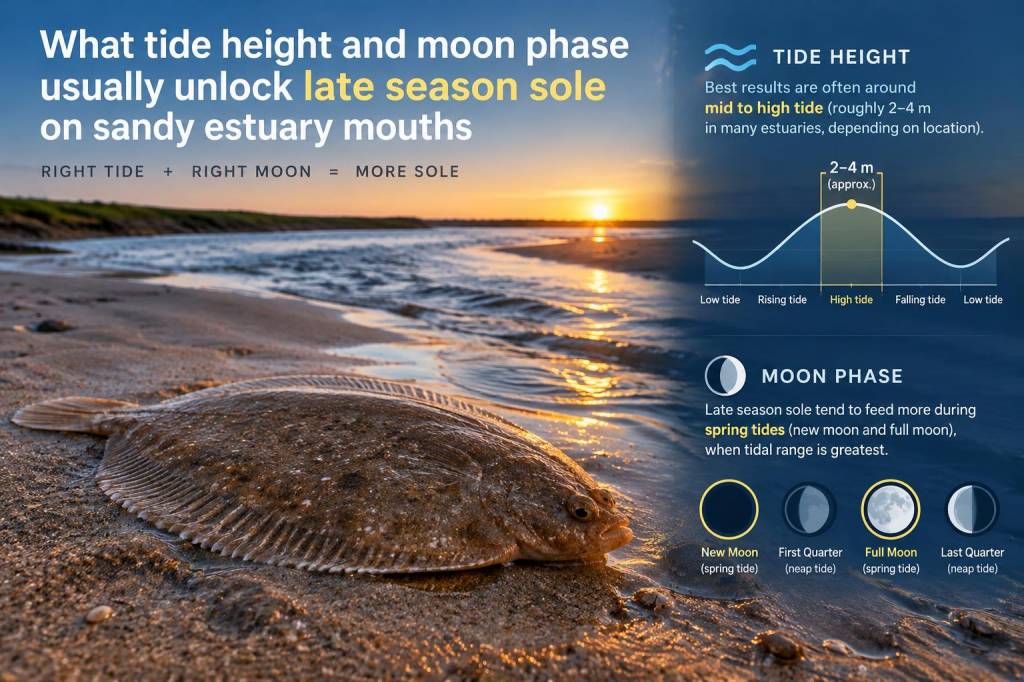
When I start thinking about late-season sole, I stop looking for drama and start looking for calm. On sandy estuary mouths, sole often seem to switch into a more cautious, close-to-bottom pattern once the water cools, bait fish thin out, and daylight hours shrink. In my own fishing, the tide height and moon phase matter less as separate ideas and more as a partnership. A good tide can put bait and fish in the right place, but the moon can decide whether that window feels lively, flat, or frustratingly subtle.
What I have learned is that late-season sole on sandy estuary mouths often show a clear preference for moderate to big tides, especially when they push enough water to wash food out of creeks, margins, and softer channels without turning the whole area into a roaring torrent. I do not mean a full-on flood every time. I mean enough height to give the fish access to feeding lanes, but not so much movement that the scent trail gets scattered and the bottom becomes hard to fish cleanly. In many estuary mouths, that means I am happiest around the middle to upper part of the tide cycle, with the most reliable action often arriving on the last part of the flood and the first part of the ebb.
I like the flood for a simple reason: it brings. It brings scent, it brings worms and small crustaceans out of the softer ground, and it brings sole closer to the feeding edges where they can patrol without wasting energy. Late in the season, when water temperatures are sliding down, I tend to find that sole are less willing to roam far from dependable food lanes. If I can fish a sandy estuary mouth where the flood starts to cover the outer flat and begins to pour through a natural gutter or drainage line, I feel I am in the right kind of place. A tide that is too small can leave the fish stranded in deeper holding water. A tide that is too large can make presentation messy and push the feeding zone out beyond comfortable casting range.
Moon phase enters the picture in a subtler way. I would never treat it as a magic switch, because I have had excellent sole sessions under all sorts of moons, but I do pay attention to it. For late-season fishing, I usually prefer brightening moon phases when they line up with a good tide, especially the days around the full moon and the days just after it, when evening or night sessions can have a bit more natural light and fish activity. At the same time, I have also done very well on a waning moon when the sea has settled and the shoreline has gone quiet. Sole do not always follow a neat rulebook, but I find that a strong tide combined with a moon that keeps the nights readable often helps me fish with more confidence.
On sandy estuary mouths, moonlight seems to matter most when the water is clear and the fish are cautious. In clear, late-autumn water, a very bright moon can make sole a little more selective. They may still feed, but the bite can become lighter and more deliberate. That is when I scale down my approach, use smaller baits, and make sure my rig sits neatly on the bottom. If the water has a bit of colour, though, moonlight often feels less important than tide movement. In slightly coloured water, sole seem more willing to move into the wash and feed by scent and vibration rather than sight alone.
My most dependable late-season sessions have often come on moderate springs rather than the very biggest tides. Big springs can be excellent if the estuary mouth has enough depth and a clean feeding lane, but they can also race through the area so fast that the fish get pushed out or the bait gets dragged into awkward ground. Moderate springs give me enough range to reach the fish at the right stage of water, while still allowing me to hold bottom and keep the presentation tidy. If I had to choose one pattern for sandy estuary mouths in colder months, I would pick a tide that floods comfortably over the sand, peaking around the time the channel begins to look full but not violent.
Slack water is another piece of the puzzle. Sole are often thought of as a species that likes gentle movement, and I agree with that in part, but I do not look for dead slack as my main moment. I prefer the edges of slack: the final push of the flood before the flow settles, or the first gentle draw of the ebb after the water has turned. Those edges seem to concentrate food without making the whole area drift too hard. On a sandy mouth, a gentle current can draw scent along the bottom and give sole a clear line to follow. Too much current, and the scent plume lifts or disperses. Too little, and the fish may not bother moving far enough to find your bait.
When I am planning a session, I often map the tide and moon together in a very practical way:
| Tide and moon pattern | What I usually expect | My approach |
|---|---|---|
| Moderate spring tide with a bright moon | Good movement, clear water, cautious bites | Smaller baits, neat rig presentation, patient bite watching |
| Moderate spring tide with a darker night | Steadier confidence, stronger feeding windows | Slightly larger bait, longer casts into the feeding lane |
| Big spring tide with coloured water | Strong chance of activity if the ground still fishes cleanly | Fish the flood edge and the first of the ebb, keep rigs simple |
| Small tide with a bright moon | Patchy sport, fish may hold deep | Target deeper pockets and wait for a better stage of water |
| Small tide with a darker moon | Very variable, often not my first choice | Only worth it if local signs point to a clear feeding line |
That table reflects my own pattern of thinking, not a strict rule. Still, it saves me from wasting a session on a setup that looks good on paper but weak in practice. I have learned to trust the shape of the ground as much as the calendar. A sandy estuary mouth with a shallow bar, a narrow gully, and a cleaner drop into deeper water can fish very differently from a broad flat mouth with little definition. If the moon is bright and the tide is small, I need a very clear feature to work with. If the tide is healthy and the water has a touch of colour, sole can spread out more and still find my bait.
Bait choice also changes with tide and moon. Late in the season, I still like worm baits above almost everything else for sole on sand. Black lug, ragworm, and peeler crab cocktails can all work, but I usually lean into scent over bulk. When the moon is bright and the fish feel shy, I often trim the bait down and make it look more natural. A large bunch can still take fish, but I find that a smaller, tidier offering is often better when the water is clear and the fish are a little wary. I want the bait to look like something dislodged by the tide rather than something presented too obviously.
Rig presentation matters just as much. On these grounds I tend to fish a low-drag setup that keeps the bait close to the sand. Sole feed with a low profile, and if the rig lifts too much or tumbles into a bad angle, I feel I lose quality bites. A fine clear leader, a tidy trace, and a hook that matches the bait size all help. I also keep my leads practical for the amount of flow. If I cannot hold bottom through the feeding window, I am probably in the wrong place or fishing the wrong stage of the tide.
Wind and river flow can shift the balance too. A bit of surface chop often helps by breaking light and giving the fish a little more confidence, especially under a bright moon. Fresh river flow can also add life to a sandy mouth by moving small food items and creating a scent trail. But if the river is pushing too hard, or heavy rain has turned the mouth into a messy plume, I will often look for a slightly slower stage of tide or move to a cleaner edge. Sole seem to like a calm delivery of food more than a chaotic flood of it.
My own notes from late autumn and early winter point to one recurring pattern: if I want to intercept sole at sandy estuary mouths, I usually want a rising tide that gives me access to the feeding zone, paired with a moon phase that does not make the fish feel overly exposed. In practice, that often means fishing the late flood under a moon that is not at its harshest, or fishing a strong flood on a darker night when the fish seem more willing to come right into the mouth. I do not worry about perfection. I worry about alignment. Water movement, bait, clarity, and light all need to sit just right, and when they do, late-season sole can appear from very ordinary-looking water.
I also pay attention to timing within the evening. If the tide peak lands just after dusk, I tend to like that a lot. If it lands in full darkness with a bright moon, I may still fish it, but I will make my first hour count by working the productive edge rather than hoping fish will suddenly arrive later. Late-season sole do not always feed for long, so I think in short windows rather than all-night marathons. A small change in tide height, or a cloud bank passing over the moon, can transform a flat session into a busy one.
One of my favourite habits is to log not only catches, but also water colour, wind direction, moon brightness, and the exact stage of tide when bites arrived. Over time, those notes reveal a pattern that is much more useful than memory alone. For sandy estuary mouths, I keep returning to the same practical formula: enough tide to move food, enough darkness to calm the fish, and enough structure to hold the feeding line. When those parts come together, late-season sole become a very real possibility rather than a hopeful guess.
What I find most rewarding is that these fish still teach me patience every year. Some sessions feel perfect and produce almost nothing. Others begin under ordinary conditions and suddenly switch on when the moon is rising, the tide has just enough push, and the sand seems to wake up under the surface. That is why I keep studying these estuary mouths so closely, because the answer is rarely one single number. It is usually a moving balance between tide height, moon phase, water clarity, and the narrow feeding lanes that sole trust when the season turns cold.