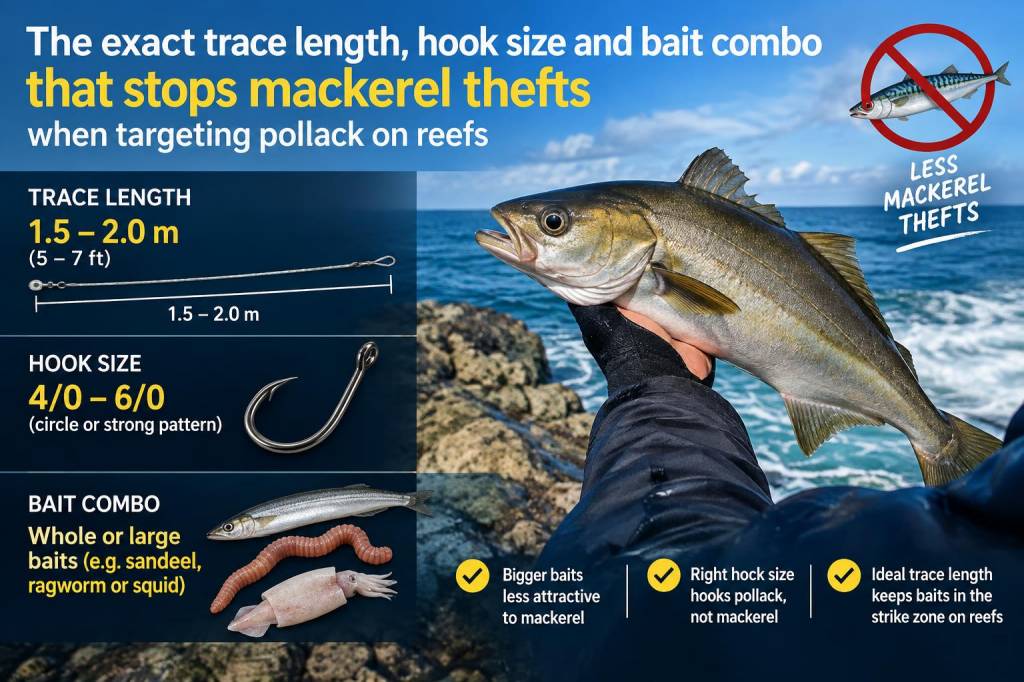
I spend more time than I care to admit tweaking rigs on windy reef marks where pollack live cheek-by-jowl with gangs of opportunistic mackerel. Over the years I’ve learned that stopping mackerel thefts is less about brute force and more about subtly changing where and how the bait sits in the water, and matching hook size and bait presentation to what pollack actually want. Below I give the exact trace lengths, hook choices and bait combos I use when I want pollack and not mackerel to steal the show.
Why mackerel steal bait (and what that means for your rig)
Mackerel are small, toothy, surface-to-midwater opportunists. They rarely take whole, well-presented baits from the seabed; instead they nip at bright, exposed strips or lures on the way down. On reef marks where the water column is busy, a long, flashy trace or a dangling strip of mackerel will read as an easy snack. Pollack, by contrast, usually take from the seabed or just above it. The trick is to present a bait that reaches the pollack zone quickly and stays there without exciting the midwater mackerel.
Exact trace length that works for me
My go-to trace length for reef pollack when mackerel are active is 30–45 cm (12–18 inches) from the swivel to the hook. This length keeps the bait close to the weight and therefore close to the seabed, reducing the time the bait spends in midwater where mackerel do most of their stealing.
When I need to ensure the bait sits absolutely on the bottom (fast tidal run or deep reef), I’ll shorten to 25–30 cm. If the pollack are feeding slightly above the bottom and mackerel aren’t too aggressive, I’ll extend to the upper end of the range at 45 cm. Anything longer than 50 cm offers too much midwater exposure and invites mackerel interference.
Hook size and style
Pollack have a good mouth and will take larger hook points; mackerel have small mouths and can often nip at the edge of a small hook without hooking themselves. I use:
For me, the sweet spot is 1/0 for cleaner presentation with smaller baits and 1/0–2/0 for the majority of reef sessions. The 1/0 size is large enough to hold a pollack securely but small enough that mackerel rarely manage to take the whole bait without getting hooked. Short-shank patterns (octopus/short-shank AB) present bait close to the hook point and reduce the chance of a mackerel nipping strips off without getting caught.
Trace material and breaking strain
I use fluorocarbon traces for abrasion resistance and low visibility. My standard is:
This thickness gives good bite resistance against pollack’s rough mouths and rock abrasion around reefs. If there’s a serious risk of tooth damage from larger species, I’ll step up to a fine wire trace on a separate hook (but that’s rare for typical pollack marks and will spook more wary fish).
Bait choice and hooking method to deter mackerel
How you hook the bait is as important as which bait you use. My favourite bait combos for keeping mackerel at bay while attracting pollack are:
My favourite specific setups:
Rig layout and weights
I fish a simple paternoster / fixed-length running ledger depending on conditions. Key points:
| Condition | Trace length | Hook size | Bait | Weight |
|---|---|---|---|---|
| Fast tide/strong current | 25–30 cm | 1/0–2/0 | Whole sandeel | 60–120 g |
| Medium tide, mackerel active | 30–45 cm | 1/0 | Half mackerel tail pinned | 40–80 g |
| Calm, pollack feeding up | 40–45 cm | 1/0–2/0 | Folded squid or sandeel tip | 30–60 g |
Rig tying steps (quick and practical)
Here’s the step-by-step I use on the bank:
Small tweaks that make a big difference
Some final practical tweaks I use when mackerel are a nuisance:
These are the exact trace lengths, hooks and bait combos that consistently reduce mackerel theft for me without sacrificing attraction to pollack. On those rocky Welsh reefs patience and tidy presentation win more fish than brute weight or ultra-long traces. If you want, I can put together a printable rig card you can keep in a tackle box with the exact knots and measurements I use — just say the word and I’ll format it up for the site.