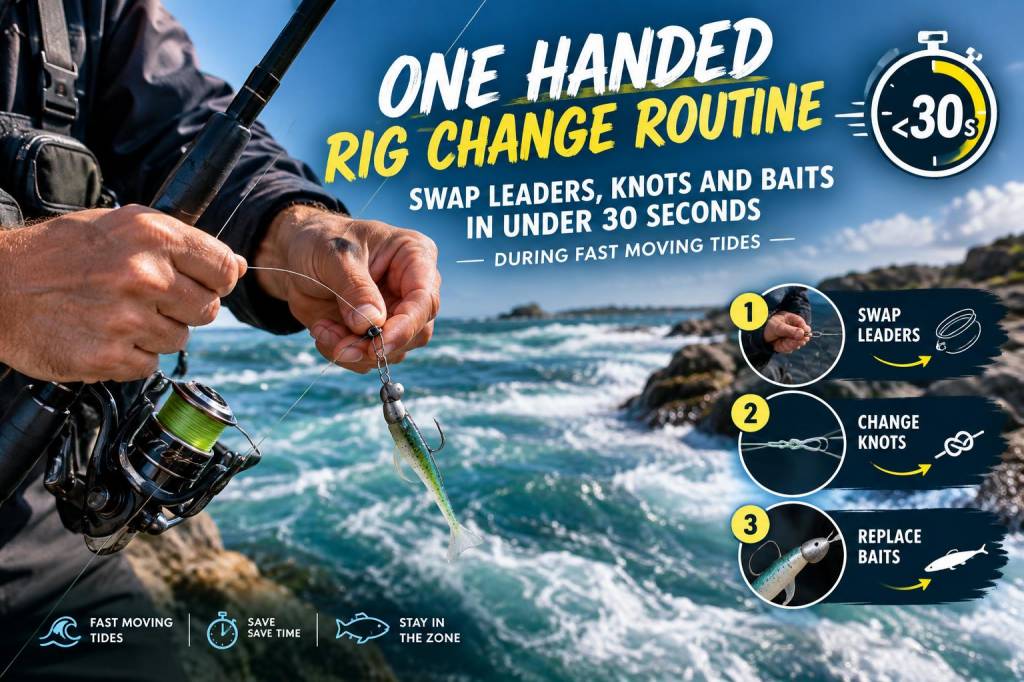
When the tide flips and the run of fish lasts only an hour, every second counts. I learned early on that being able to change leaders, knots and baits with one hand is a game-changer. Whether you’re balancing on a rock, bracing against wind, or juggling a lamp and a landed fish, a slick one-handed routine keeps you fishing during those crucial fast-moving windows. Below I walk through my exact sequence — gear, pre-tied setups, one-handed knot choices and a repeatable routine that gets me back on the cast in under 30 seconds.
Why one-handed changes matter
Coastal tides in Wales can turn a spot good — then better — in minutes. When bass or pollack show up, hesitation means missed opportunities. Doing quick swaps without needing two hands or to sit down for a long knot-tying session keeps me present on the bank and ready. It’s also safer: you don’t risk dropping gear or losing balance while fumbling with tools.
Gear I always have on me
- Pre-tied leaders in small waterproof tubes — I carry leader lengths for light, medium and heavy shore fishing (1.5m, 2.5m, 3.5m).
- Snaps and quick-change swivels such as Euro-style snaps or Savage Gear quick snaps for fast lure swaps.
- Thin shock/leader material (30–60lb braid-to-leader), plus 10–20lb fluorocarbon for finesse.
- Hook packets sorted by size: #1 to 4/0 depending on species.
- Line cutter or nippers clipped to my belt so I never have to fumble in pockets.
- Small magnet clip or lanyard to keep forceps and a small folding knife reachable with one hand.
- One-handed knot repertoire: Uni-knot variant for braid-to-leader, and a triple-wrap FG or a locked overhand for leader-to-hook when needed.
Prepping a one-handed kit (do this at home)
I do most of the fiddly work in my kitchen before I leave. That preparation is the secret to consistently sub-30-second swaps.
- I pre-tie a set of leaders with a small loop at the butt end and a snap swivel at the business end. The loop makes it quick to attach to a mono/braid loop or to a loop-to-loop arrangement.
- I use consistent colour coding: green tubes for light leaders, blue for medium, red for heavy. This removes guesswork in rough light.
- I make a stack of spare rigs (short trace + hook/clip) on a small strip of foam — these sit near the leader tubes.
- I store snapped rigs in a small dry box labelled with hook size. When a bait changes, I grab a pre-rigged strip and clip it on.
My under-30-seconds routine (one-handed)
Practice this slowly until the motion is smooth. When the tide runs, you’ll be able to speed up without mistakes.
- Step 1 — Secure the rod: stick the butt under your arm or use a short rock ledge as a rest so your free hand can move. I often slip the reel’s bale under my forearm and use thumb pressure to keep tension.
- Step 2 — Cut and leave a short tag: with your nipper, I make a quick cut of the old leader or trace, leaving a 2–3cm tag attached to the main. This lets me quickly find and open the loop-to-loop or knot without unspooling the reel.
- Step 3 — Pull off old rig: using one hand I pinch the tag and slide the old leader off the reel spool or detach the snap. If I used a blood loop or a small loop-to-loop, it slips away with a small tug. This is where pre-tied loops pay back tenfold.
- Step 4 — Attach new leader: I grab the pre-tied leader tube, remove it, and attach the leader loop to the main loop. If I’m using braid with a loop, a simple loop-to-loop join or a lightweight quick-snap gets the job done in one motion. If I need a more secure braid-to-leader join, I keep a pre-tied micro Uni with a short tag in my leader tube.
- Step 5 — Snap on a pre-rigged hook or lure: the snap swivel on the leader accepts my foam-strip rigs instantly. Clip, give a short tension, and you’re ready to cast.
Knots I use one-handed
Not all knots are realistic one-handed, so I pick ones that are both strong and quick to deploy.
- Loop-to-loop — perfect when both mainline and leader have small loops. No knot-tying required on the bank.
- Pre-tied micro-Uni or clinch variants — I tie these at home and keep them as spares. A micro-Uni is compact and reliable for braid to mono/fluoro when secured properly.
- Snaps and quick swivels — while not a knot, they replace a lot of on-bank tying. I choose stainless Euro snaps for corrosion resistance.
When I do need a secure on-the-spot knot
Sometimes you can’t avoid a full knot — a lost leader or an unexpected need for a thicker trace. For these instances I use a very quick locked-uni that I can finish with one hand and a small loop of the line tucked under my foot or between rocks to hold tension.
| Situation | One-handed solution |
|---|---|
| Fast shoal of bass arrives | Swap to short 1.5m leader with a pre-rigged lure on a quick snap (15–20s) |
| Hook straightens or trace snaps | Clip on a foam-strip spare rig to leader loop (20–30s) |
| Need heavier shock leader | Attach pre-tied heavy leader tube loop-to-loop and snap on baited hook (25–30s) |
Practice drills
I rehearse these moves at home with a chair and a spare rod. Time yourself, record small improvements and practise in gloves to simulate winter sessions. The drills I repeat:
- Loop-to-loop joins in under 10s.
- Swap a pre-rigged strip on a leader while balancing the rod in my armpit.
- Cut and strip a leader end cleanly with nippers using just one hand.
Common mistakes to avoid
- Not dressing equipment consistently: if your spares are all different lengths or configurations, swapping becomes slower.
- Relying on wet hands and tiny knots: keep an alcohol cloth for quick drying and use larger knots when you have to tie on the beach.
- Overcomplicating the leader: for fast changes, simplicity wins — a strong, short leader with a snap outperforms a huge, awkward trace.
I tune this routine to match conditions. On calm nights I might take 45–60 seconds to tie a bespoke leader; during a tide rush, the one-handed sequence above gets me back on the cast quickly while keeping tackle reliability high. If you want, I can share a printable checklist or a kit list you can use to build your one-handed system before your next session.