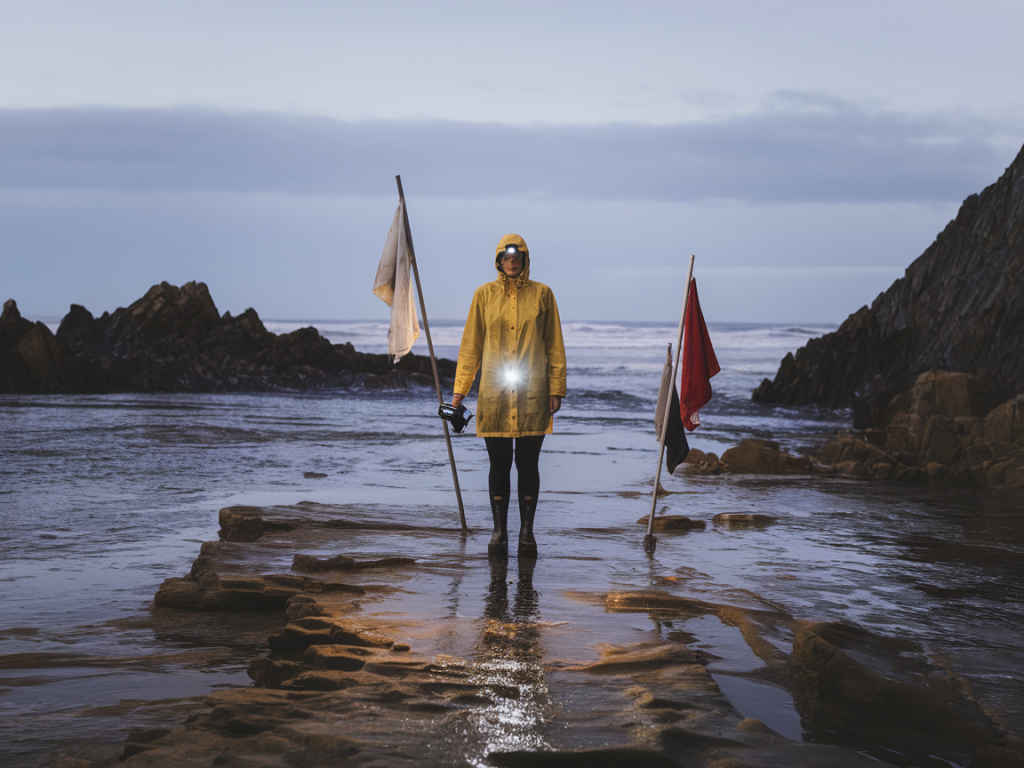
Why I map exit corridors before the tide takes the shore
I’ve had a few too many heart-stopping moments on tidal ledges to treat exits as an afterthought. When the sea comes in fast and the rock goes slick, it’s the exits you’ll thank yourself for. Mapping safe exit corridors with a headlamp, compass and simple tide flags has become a routine for me — it’s quick, low-tech and almost always keeps me off the sea’s timetable. In this guide I’ll walk you through how I do it on nights and early mornings, what gear I use, and the things I check before I set up for a session.
What I mean by an “exit corridor”
An exit corridor is a clear, rehearsed path from your fishing spot up and off a ledge to higher, safe ground. It’s not just the shortest line back to the carpark — it’s the one that stays accessible at the highest tidal state you expect, avoids deep gullies, and has decent footing even when wet. I pick at least two corridors when I’m shore fishing: a primary and a backup.
Gear I always have in my hand
I keep my kit simple and reliable. At night I want tools that work in the cold and when my hands are shaking.
Headlamp: I prefer a wide-beam headlamp with a red mode. I use a Petzl Actik Core for a good balance of flood and spot beam, but any 300–500 lumen unit with red light will do.Compass: A basic lensatic or baseplate compass — I carry a Silva Expedition or a cheap baseplate from Cammenga. It lets me take bearings and relate the path to my carpark or landmarks.Tide flags: These are just strips of brightly coloured tape (I use 10mm electrician’s tape or tie on 20mm nylon ribbon). They don’t need to be fancy — they’re temporary markers.Marker drop: Small GPS or phone with offline map is useful but I don’t rely on it for quick exits — battery and signal can fail.Grippy footwear and gloves: Scandi soles or Vibram with good studs, and thin grippy gloves to keep dexterity for knotwork and compass use.Step-by-step: how I map an exit corridor
Here’s the routine I run through before I fish on a slippery ledge.
Scout from above first: If possible I walk the higher shore at low tide to identify natural routes: pebbled ramps, rock steps, boulder fields and any overhangs. I note gullies that fill quickly.Set up primary position: I pick my fishing spot and stand where my rod will sit. With my headlamp on low white beam, I look around and visualise a route that stays dry at the predicted high tide.Take a bearing to a fixed landmark: Using my compass I take a bearing from my fishing spot to a clearly visible fixed landmark — a telegraph pole, a cliff corner, a distinctive rock stack or the carpark sign. I write that bearing down on my notepad or memory (e.g., “bearing 215° to the big white tower”). The bearing helps me re-orient if fog or rain obscures sightlines.Mark the corridor with tide flags: I walk the route you plan to take and attach tide flags at eye-level on rocks, short sticks stuck into cracks, or seaweed-free holds. Place flags at regular intervals — about every 6–10 metres — so you have a visual guide when your headlamp only shows a short distance ahead. Use two colours if you can: one for the primary route, another for the backup.Test your footing in the dark: Walk the corridor deliberately with your pack on and light as it would be when you leave. If there are slippery plates, try tracing the edges where barnacles aren’t as abundant. If a section feels risky, move the flags and adjust the path.Set a high-water marker point: Identify where the water will start to close the corridor. Stand at the highest point you intend to reach and get its bearing back to your fishing spot. This becomes your “don’t go above” or “minimum escape” point if the tide rises faster than expected.Using a compass effectively at night
A compass is simple but invaluable when visual cues fade. Here’s how I use it:
Take and write down two bearings: one from your fishing spot to the carpark/landmark and another back from the landmark to a refuge point. If you misjudge the route, you can walk to the landmark and then follow the reverse bearing.Check bearings periodically. Moisture on the lens or a magnetic influence from your headtorch clip can cause error — hold the compass away from electronics when possible.Use the compass together with your headlamp beam: sweep the lamp across the horizon until you pick out the landmark on the bearing and lock it into sight.Why tide flags work better than GPS alone
Phones and handheld GPS units are great, but at night and on cliffs they can be practically useless: screen glare, battery drain in cold, and water damage all matter. Tide flags are tactile and visual at close range — they don’t need power, and they survive the wind. Because I place them along the actual walking line they become a physical rehearsal of the corridor.
Checklist table I stick to before I stay late
| Checklist item | Why it matters |
| Primary & backup corridors flagged | Two options reduce risk if one route is cut off |
| Bearings noted to landmark | Reorientation when visibility is poor |
| Footing tested in full kit | Find slippery spots before you need them |
| Red light ready | Preserves night vision when scanning the flags |
| Tell someone your plan | Essential if you can’t make the exit |
Practical tips I’ve learned the hard way
There are a few habits I’ve developed that make exits far less stressful:
Keep your headlamp on low until you need a full beam: low light preserves night vision and makes your eyes more sensitive to the flags' colours.Use red light for close navigation: red is less dazzling and doesn’t wash out colours.Don’t clip magnets or batteries near your compass: They’ll skew readings and waste time when you need a straight bearing.Walk the backup route immediately after setting it: I’ll always walk my backup once so I know it’s actually passable after the flags are in place.Replace flags at each session: I remove my tide flags on the way out. Leave nothing behind but footprints.Final operational notes
Mapping exit corridors is about lowering variables you can control. The sea will always surprise you, but spending five to ten minutes planning and flagging a safe route gives you options when conditions change. Make it a ritual — it’s probably the most important part of the session that isn’t your rod. If you want, I can share a printable compass bearing sheet I use on nights out — drop me a line through the contact page and I’ll email it over.