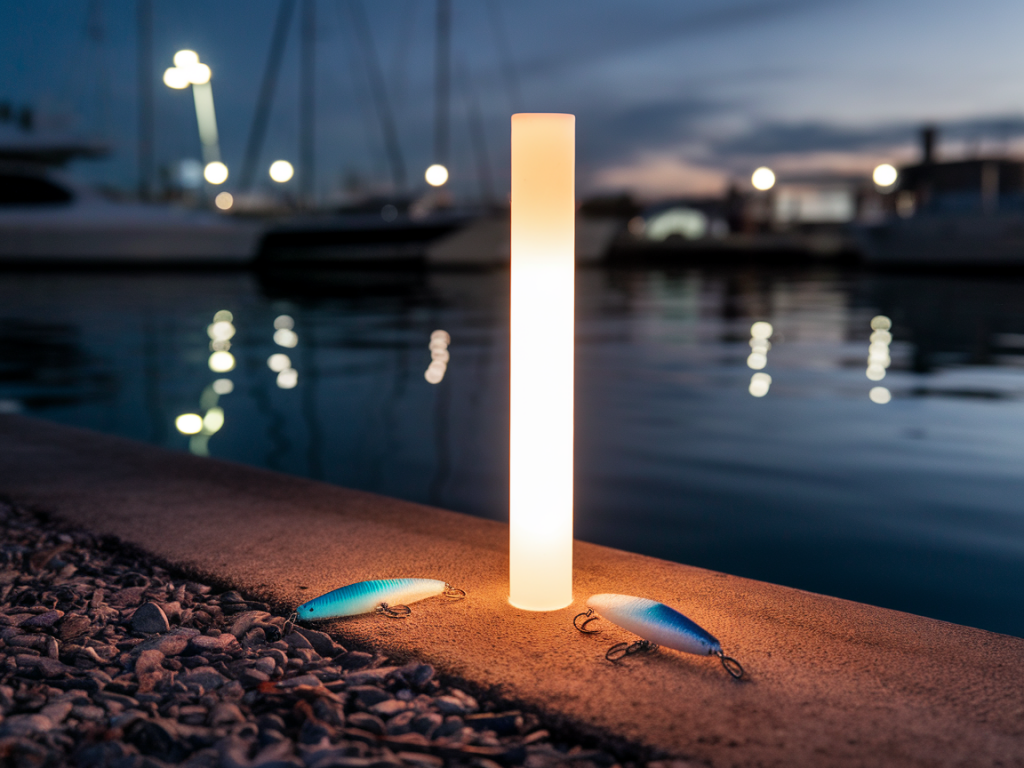
I walked the pontoon at low tide the first time I noticed how lights change everything. Under marina lamps the estuary becomes a corridor of silhouettes and suspended life — fry and shrimps schooling in the glow, small crabs skittering along mooring ropes, and bass patrolling the edges like ghosts. If you want consistent bites on evening sessions, two things matter: where you put your glow-stick and which micro-lure profile you present. Below I’ll share the exact glow-stick placement I use for reliable hookup rates, plus three micro-lure setups that keep getting bass under lighted pontoons and slipways.
Why glow-sticks matter more than you’d think
Glow-sticks do two jobs. First, they give you a reference point in low light — a landing marker for your cast and an alignment tool for your drift. Second, they change fish behaviour by creating a small column of light that concentrates prey. Bass are ambush hunters; they’ll sit on the edge of that illuminated column waiting for a shoal to drift past. That means placement isn’t decorative: it dictates where fish will appear and how they will approach your lure.
Exact evening glow-stick placement I use
I use 8–10mm stick-on glow-sticks (the tubular LED-style or the stick-ons from brands like Cyalume or local fishing suppliers). Here’s my routine before every cast:
Practically, that looks like this: cast parallel to the pontoon with your glow-stick angled inshore (toward the piling) and let the drift or slow retrieve keep the lure skating unseen just beneath the light. If you place the glow directly above the lure, you outside the silhouette effect — bass see the light and the lure in the same plane, which can spook wary fish. By offsetting it slightly, the light acts as a pointer into the dark strike zone.
How far from the structure should your glow be?
Distance depends on tide and water clarity.
Rig setup and terminal tackle
I fish micro-lures on 10–12lb fluorocarbon leader tied to a 15–20lb braid mainline (0.15–0.20mm). The braid gives sensitivity under lights — you’ll feel the light tapping of small fish and the heavier thump of a bass. I use small 1/0 to #1 hooks depending on lure size, and a 5–15g micro jig head to keep the lure in the strike zone. Swap weights to match the current: heavier when it’s ripping, lighter when it’s glassy.
| Item | Specification | Why |
|---|---|---|
| Leader | 10–12lb fluorocarbon | Low visibility under marina lights |
| Mainline | 15–20lb braid | Sensitivity & control |
| Hook | 1/0 to #1 micro hooks | Holds small lures, good penetration |
| Weight | 5–15g micro jig heads | Matches depth & current |
| Glow | 8–10mm stick-on or LED | Small, visible column; low disturbance |
Three micro-lure profiles that consistently trigger estuary bass
I rotate between three profiles depending on the conditions. Each profile follows a simple behavioural trigger: profile A imitates paused/shocked prey, profile B mimics local shrimp/fry, profile C provokes reaction strikes with flash and vibration.
Lure type: 2–3" soft grub, paddle or curl tail; 7–10g jig head.
When to use: clear water, cooler months, or when bass are holding tight to shade lines.
Action: short sharp twitches followed by a 1–3 second hold. The hold is the killer — bass are attracted to prey that stops in the light column. I twitch three times, count two, twitch once, then let it rest. Glow-stick offset shows the bass exactly where to strike under the light.
Lure type: 1.5–2.5" shrimp imitations or slim minnow soft baits; 5–8g micro head.
When to use: warm water, summer nights, when marina lights are heavy with small baitfish.
Action: steady slow retrieve with intermittent short pauses — imitate a wriggling shrimp drifting in the light. Keep the lure slightly deeper than the glow-stick so bass have to move up into the light to grab it; that vertical motion triggers follows into strikes.
Lure type: micro metal jig or vibrating minnow with internal rattle (3–8g).
When to use: choppy conditions or when bass are aggressive (high tide or strong incoming flows).
Action: fast strips with occasional sharp jerks. The flash and rattle cut through turbidity and mimic a fleeing baitfish. I tend to use this profile when visibility is reduced but the bass are active — the noise and flash get attention under lights.
Reading bites and setting the hook
Bites under marina lights are often subtle at first — a light knock or change in line speed as a bass eyes your offering in the glow column. With 15–20lb braid on the reel I lean into every hesitation. Don’t wait for a full pull. A firm, sideways sweep of the rod into the piling silhouette usually results in solid hook-up; vertical lifts can pull the lure out of the jaw in shallow water.
Practical tips I use every session
When it all comes together — the glow in the right position, the micro-lure profile matching what the bait is doing, and a patient retrieve — those evening bass hit like freight trains in miniature. The first few sessions with this method taught me to trust the light and keep the lure understated. Under marina lamps, less is often more.