I won't pretend there's a single magic trick to pull double-figure rays off slippery tidal ledges — but after a few seasons of stubborn dawns, soaked waders and the odd ecstatic shout when a big shoulder rolls at the surface, I've learned a reliable pattern: exact peeler timing plus the right bait preparation will dramatically increase your odds. Below I walk you through the timing, bait prep, rigs and on-the-rocks tips I use when I’m chasing big rays from Wales' ledges.
Why peeler crab works so well for rays
Peeler crab has a texture and scent that rays absolutely love. It holds on the hook better than mussel or ragworm in rough water, offers a strong meaty profile that carries out on the tide, and when prepared correctly gives off a slow scent trail that can attract a cruising ray from distance. It also presents naturally — the shell fragments and soft body create an easy mouthful for a ray whose feeding behaviour favours suction and slow tearing rather than aggressive strikes.
Exact timing: when to fish peeler for double-figure rays
Timing is everything. For me the productive window is tightly tied to tide movement, not just "high" or "low". I aim to be on the ledge and fishing during the period from roughly one hour before high tide through to two hours after high tide on an incoming or full slack. On exposed tidal ledges this window coincides with the peak flow when rays move up to feed the slicks and gullies.
Key timing rules I follow:
Preparing peeler crab for ledge work
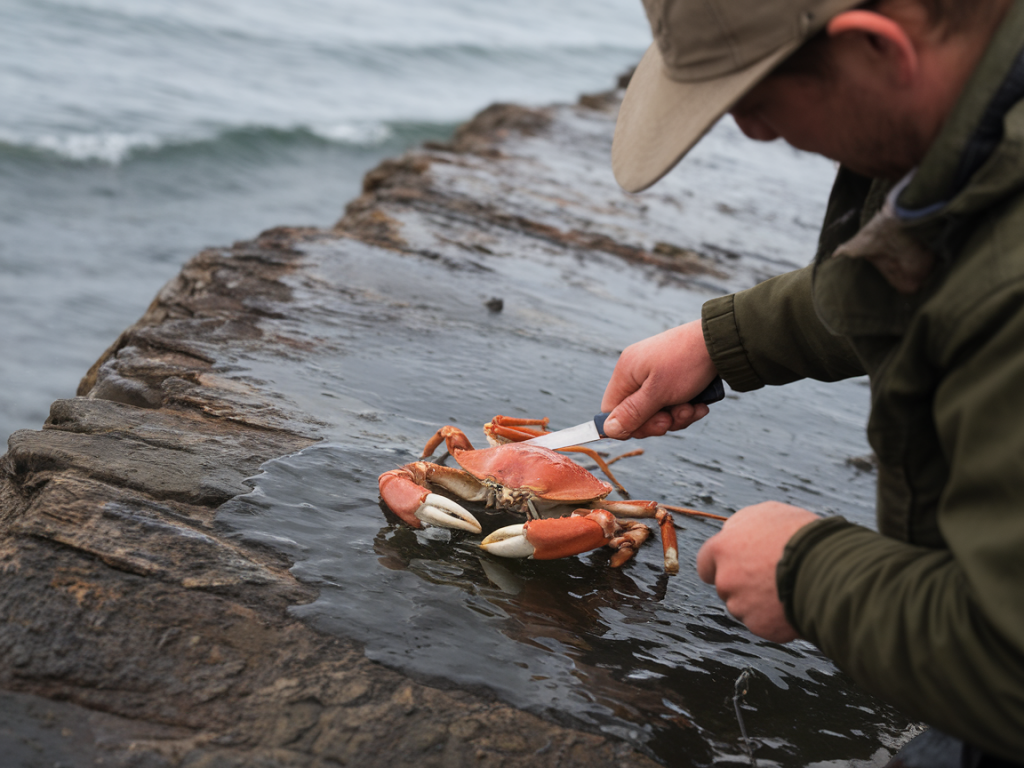
Not all peeler prep is equal. Sloppy bait will come off in the swell or fail to give the natural profile rays want. I use these steps every time:
How I secure the bait:
Hooking techniques that trigger solid takes
I switch between two hooking patterns because each has benefits on ledges:
Preferred hooks and sizes: I use circle hooks or wide-gape straits in sizes 4/0–7/0 depending on how big the peelers are and how big the ray I’m targeting. For double-figure rays 5/0–7/0 works well.
Rigs for tidal ledges
Rigs matter on ledges. You want a set-up that anchors on the bottom but lets the bait move naturally in the current — and that stays attached to the rock rather than getting swept into a crevice.
| Condition | Typical sinker | Leader |
|---|---|---|
| Calm tide, small swell | 4–6oz | 50–60lb fluoro |
| Moderate tide, exposed ledge | 6–10oz | 60–80lb fluoro |
| Strong tide, heavy swell | 10–14oz | 80–100lb fluoro |
Line, reel and rod choices
I fish braid mainline (15–30lb braid depending on distance) with a heavy mono shock leader — braid gives sensitivity and quick drop through the water; mono/fluoro leader offers abrasion resistance and some stretch for playing big rays off rock. My go-to rod is a 12–13ft shore rod in the 4–6oz class: long enough for distance casts but with backbone to steer a big ray away from structure. Reels: a 6000–8000 size spinning reel spooled with braid and a good drag set-up (I trust a Penn or Daiwa for the drag reliability).
Reading the ledge and bait placement
Where you place your bait is as important as when. Look for gullies, shallow gutters or the edges of kelp beds where rays cruise. Cast upstream of those runs so the bait drifts naturally into the feeding zone. Avoid packing baits tight to rock faces where the ray can crush or bury the bait — a couple of meters off the rock along a current seam is often perfect.
Landing and handling double-figure rays
Big rays are heavy, floppy and can be dangerous if mishandled. I always:
Final practical tips I use every trip: bring spare bait prepped and chilled, pack elastic and baiting needle, and always check local bylaws and seasons. Respect the coast, keep an eye on the tide, and never underestimate how quickly conditions change on a tidal ledge. Fish the exact peeler window, make your bait secure but natural, and you’ll be giving yourself the best possible chance at a double-figure ray.