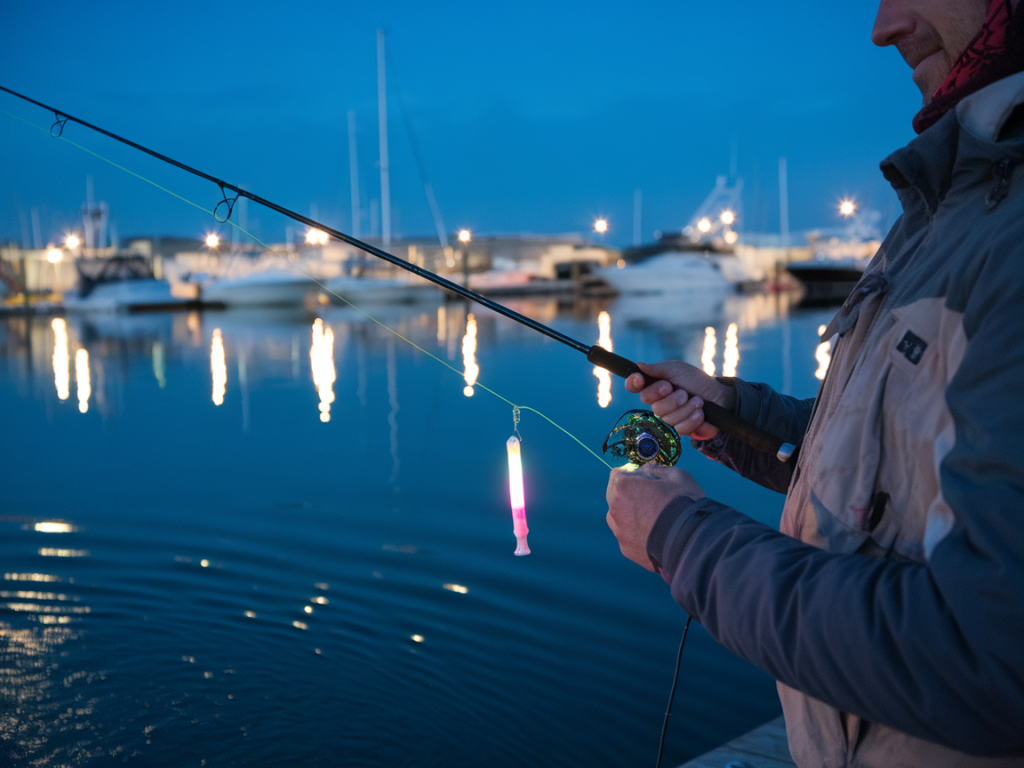
Marina lights are one of those relentless, honest attractors: they concentrate prawns, small fry and baby sandeels right where concrete meets water. Over the years I've found that bass feeding under pontoon and quay lights behave differently to fish on open shorelines — they're aggressive, short-striking and can be cautious of bulky glow. Getting your glow-stick placement and lure profile dialled will convert more of those tentative follows into confident takes.
Why glow placement matters under marina lights
Lights strip away the darkness the fish use to ambush prey. That creates a tight feeding band directly under and around the light cones. If your glow is too high or too far away from your lure you end up presenting an artificial that looks disconnected from the tiny baitfish the bass are targeting. Too close and you can spook them — a bright blob of light right on top of your lure looks unnatural.
My aim is to mimic the contrast bass expect: a small, moving silhouette with a subtle glow that reads like a flashing prawn or injured fry in the light cone. That usually means keeping the glow within a short, controlled distance from the lure and using lure shapes that match the local forage.
Exact glow-stick placement I use
- Vertical offset from lure: 30–45 cm (12–18 in) above the lure on the leader for most situations. This keeps the glow visible in the light cone without sitting directly on top of the profile.
- Lateral offset: If you can, present with the glow slightly off to one side — 10–20 cm (4–8 in) lateral — so the silhouette looks like a small, lit-up fry moving near the main target. This is easiest when fishing from a fixed point like a pontoon; a small swivelling clip lets the glow sit to one side.
- Distance from structure: Cast so the glow sits just inside the light cone boundary where bait congregates — not right under the lamp where visibility is maximum, but where shadows break up. That’s usually 1–3 m from the lamp depending on its intensity.
- Depth positioning: Match the depth of the glow to where the bait is. Under marina lights bait often suspends 0.5–2 m down. If the water column is shallow, keep the glow closer to the surface; in deeper berths I’ll let it run down 1–1.5 m.
These distances are a starting point — I tweak them based on water clarity, lamp brightness and how the fish react. On nights when prawns are thick and the bass are feeding low, I’ll drop the glow to 25 cm above the lure; when fish are skittish I’ll extend to 50 cm and soften the light by wrapping it with a small piece of coloured tape.
How I rig the glow with different leaders
My usual estuary setup for under-lamp work is deliberate and simple:
- 8–12 ft light-action sea rod for finesse and hook control.
- 2500–3000 size reel loaded with 12–15 lb braid (for sensitivity) with a 20–30 lb fluorocarbon shock leader if tides are strong.
- 20–30 cm fluorocarbon leader to the lure for stealth.
- A short (30–45 cm) dropper to a small glow-stick attached with a micro clip. I place a rubber bead as a buffer between clip and swivel to reduce clatter.
- For bait-style setups, a paternoster with the glow on the top dropper and a baited hook 40–60 cm below works well to imitate a lit prawn above feeding fry.
My go-to knot for trailers and droppers is a simple loop-to-loop with a small swivel between leader and dropper. The swivel prevents twists from the moving glow and keeps your lure action true.
Lure profiles that consistently trigger estuary bass under lights
Bass under marina lights favour five general profiles. Below is a table I use as a quick checklist when packing the shoulder bag before an evening session.
| Profile | Size / Weight | Action | When to use |
|---|---|---|---|
| Micro plug | 40–60 mm, 3–6g | Twitchy, tight wobble with surface snaps | Clear water, small fry present, tight structure |
| Shallow jigging soft bait | 60–80 mm, 5–15g head | Subtle fall, tail flick on lift | Light current, prawn activity, low visibility |
| Crank/soft swimbait | 70–100 mm, 10–20g | Roll and flash, medium profile | When bait is larger (sandeels/finger mullet) |
| Sandeel/needle profile | 90–130 mm, 8–18g | Straight run, small tail action | Strong light cones, calm surface |
| Vertical jig (micro metal) | 10–20g | Fast flutter on fall, sharp strike triggers | Under piers and directly beneath pontoons |
Retrieve style and cadence
Under lights the takeaway isn’t a long steady retrieve — it’s a conversation. Small pauses, one or two sharp twitches, then a slow sink. I favour three basic retrieves:
- Twitch + Pause: Two firm twitches, 1–2 second pause. Repeat. Great for micro plugs and swimbaits where bass follow and nail on the pause.
- Lift & Fall: Lift the rod tip 40–60 cm, reel the slack, let the lure fall free. Bass often hit on the drop because it imitates a disorientated prawn or fry.
- Vertical Wiggle (for metals): Drop down into the light cone and jig with small, sharp rod lifts. This works under pontoons where fish hold tight to structure.
When I’m working a boat marina I'll vary the cadence depending on fish mood. Active fish will follow fast — increase twitch frequency. Hesitant fish need more pauses and a subtler glow placement.
Glow types and practical notes
- Chemical glow sticks (6–8 in): Cheap, bright and disposable. I choose these for a broad, diffused glow. Clip them with small micro clamps so they hang naturally. Cyalume-style sticks are reliable for 6–8 hours.
- Small LED glow sticks: Rechargeable and adjustable brightness. Useful when I want to tone down intensity or change colour. Less buoyant than chemical sticks, so check clips and balance.
- Toning the glow: If a glow is too bright I wrap a single turn of black tape — it reduces intensity without changing shape. Alternatively, switch to a smaller 4-inch stick.
Common mistakes and what to avoid
- Putting the glow directly on the lure. That creates an unnatural hotspot and will spook fish.
- Using oversized lures that don’t match local forage. Big profiles under lights can look like a predator and get ignored.
- Ignoring current direction. Always present across the feeding lane, not against it; let the natural drift match how the bait would move under the lamp.
Gear recommendations I rely on
I fish with a light 10–30g coastal rod — something like the Shimano Beastmaster Light or similar blank feel. Reels in the 2500–3000 range spooled with 12–15 lb braid give the sensitivity and hook setting power you need without over-committing bulk. For metal jigs I use 20–30g heads; for softbaits a 6–14g jig head lets the bait move naturally. For glow clips I prefer micro stainless clips that don't rust and a small bead to stop the clip from banging the knot.
Fishing under marina lights is about subtlety and timing. Dial in the glow placement, choose a lure that mimics the forage, and keep your retrieves conversational rather than aggressive. When you get it right, the reaction strikes from estuary bass under lights are some of the most satisfying, immediate takes you’ll get along the Welsh shore.