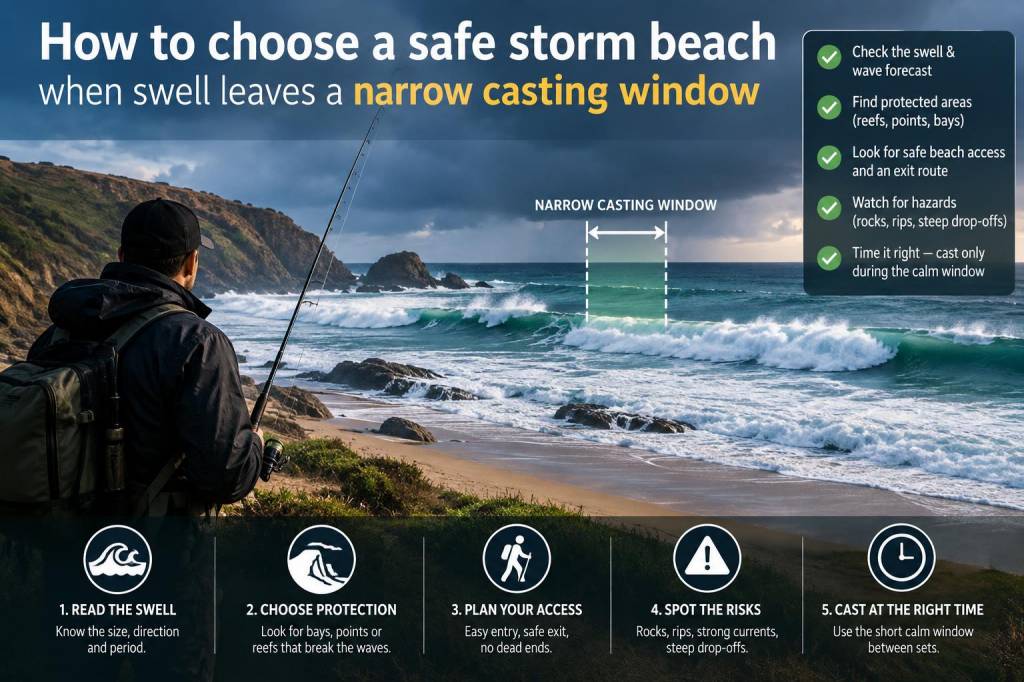
When a swell narrows my casting window, I stop thinking like an angler chasing distance and start thinking like someone choosing a place to stand for the next few hours. A storm beach can look inviting from the car park: long clean surf, fresh oxygen in the water, birds working the foam line, and that brief feeling that everything is alive. It can also turn ugly very fast. My first rule is simple: if I cannot explain why a stretch of beach is safer than the next one, I keep walking.
I have lost count of the times I arrived expecting a broad, fishable shore and found only a thin strip of firm sand between breaking water and a cut bank, with gullies pulling hard and waves folding far higher than they looked from the road. That is exactly when poor decisions happen. The fish may be there, but I only commit when I can identify a safe exit, stable footing, and a clear margin if conditions build quicker than forecast. For me, safety is not separate from angling success; it is part of the decision to fish at all.
What I look for before I carry a rod onto the beach
I begin with the forecast, but I never stop there. Wind speed, wind direction, tide state, swell period, and tidal range all matter together. A small swell on a spring tide can expose more ground than a larger swell on a neap tide, while a strong onshore wind can add just enough chop to make an otherwise manageable shore feel unstable. I want to know not only what the sea is doing now, but what it is likely to do while I am committed to a section of coast with limited retreat.
Before I leave home, I check for three things:
If any one of those looks uncertain, I reduce my ambition. Sometimes that means fishing shorter sessions. Sometimes it means choosing a different beach entirely. I would rather arrive with a smaller plan than need a rescue because I tried to force a spot that looked good on a map.
Reading a storm beach on foot
The first minutes on the sand tell me more than any app can. I watch where the waves break, where they flatten, and where backwash rebounds. A safe storm beach usually gives me at least one stable zone where I can stand, cast, and move without crossing collapsing ground or ankle-deep undertow channels. If I see constant reworking of the sand under my boots, I treat that as a warning sign, not a challenge.
I also study the shape of the beach. A gentle, even slope is usually easier to manage than a steep face that drops into a deep trough. Rips can be useful for fish, but they are not always friendly to anglers. If a rip is pinned between rocks or fenced by soft sand, it can create awkward currents where wading becomes risky. I want enough water movement to stir food and draw predators, but not so much movement that I cannot recover my footing if a wave hits while I am turning, rebaiting, or landing a fish.
Another detail I never ignore is the shoreline debris line. Seaweed, driftwood, and scattered shingle often reveal where the last heavy push of water reached. If that line sits uncomfortably close to the area where I would normally set my rod rest or bait box, I know the beach may already be working inside its limits.
Where a narrow casting window changes the decision
A narrow casting window means I have only a short safe lane to reach fishable water. That can happen when surf is heavy but not breaking every few seconds, when steep banks force me into a small gap, or when rocky edges leave just one or two places where a rod can be swung without danger. In those conditions, I do not pick the best-looking swim; I pick the swim with the most forgiving failure points.
That means I ask myself very plain questions: Can I step back if a wave surges? Can I move sideways without climbing slippery rock? Can I land a fish without bending into a dangerous position? Can I check the line without taking my eyes off the water for too long? If any answer is no, I look elsewhere.
I also think about gear placement. In a tight window, clutter becomes a hazard. I keep the unhooking mat, bait bucket, and spare rod behind me and off the main path I use to retreat. I do not stack tackle near the water’s edge just because it is convenient. A beach that seems calm for ten minutes can suddenly ask for a quick move, and I want every piece of gear to help, not trap me.
Signs I treat as a hard stop
There are moments when I do not negotiate with conditions. I leave if I see repeated wave sets reaching farther than the last one, if the beach profile is shrinking while I am standing there, or if spray is carrying inland over the area where I would normally move. I also walk away if I cannot see the full shape of the next section because of darkness, fog, or rain that blurs the line between surf and land.
I am especially cautious after dark. Night can hide small drops, exposed rock, and channels that are easy to cross in daylight but awkward to find on the way back. A storm beach at night demands more than confidence. It requires discipline, light, and a clear plan for the return journey. If I am unsure where my retreat path runs, I do not fish there alone.
My hard stop list usually includes:
Matching species logic with safety logic
I still fish with the species in mind, because the sea does not reward random casting. Bass may hunt along the edge of white water, while cod or other winter fish may sit closer to deeper gutters and broken ground. But I do not let fish behaviour override shore safety. I can adjust presentation, casting angle, or bait choice. I cannot easily adjust a beach that is already unsafe.
When the swell leaves only a slim window, I often shorten the session and simplify the approach. A single rod, a straightforward rig, and a practical bait choice make sense. I want fewer things to manage when conditions demand constant attention. I have found that simpler set-ups help me stay alert to the water rather than getting buried in tackle changes.
That is also where local knowledge matters. A beach that fishes brilliantly on a heavy push may still be a poor choice if the usual entry path floods early or if the safest stand point is too close to the waterline for comfort. I would rather learn those details from careful observation than from a mistake.
A practical risk check I use before fishing
| Check | Question I ask | What I do if it feels wrong |
|---|---|---|
| Forecast | Is swell, wind, and tide combination stable for my session? | Shorten the trip or change venue |
| Footing | Can I stand and move without slipping or sinking? | Move to firmer ground or leave |
| Exit | Can I retreat quickly without climbing or wading? | Avoid the swim entirely |
| Water line | Is the sea staying within a predictable lane? | Watch longer before casting |
| Visibility | Can I see the beach shape and wave sets clearly? | Wait for better light or move on |
What I carry when I expect rough conditions
I pack with the assumption that I may need to move quickly. A headlamp with fresh batteries is non-negotiable after dusk. I also carry a phone in a sealed pouch, a simple first aid kit, and a means of telling someone where I am going. If I am fishing a remote shore, I send a location pin or a clear message before I start. That habit takes seconds and can matter a great deal if conditions change.
My clothing choices are practical rather than fashionable. Good boots with proper grip, layers that stay warm when damp, and a waterproof shell make a real difference when spray and rain start to build. I also avoid wearing anything that makes movement awkward. If I need to climb, sidestep, or crouch quickly, I want my clothes to help me, not slow me down.
I keep tackle compact. A long carry, a slippery beach, and a tight casting lane are a poor combination for overloaded bags and loose accessories. My aim is to arrive ready to fish, not to create extra obstacles between myself and a safe retreat.
Rules, respect, and local responsibility
Safety and regulation belong together on storm beaches. If a stretch of coast is restricted, if access is closed, or if local notices warn against use, I take that seriously. I also respect seasonal limits, local bylaws, and any protected areas that may affect where I can fish. A good session never depends on ignoring rules or pushing into places that are off-limits.
I also think about other users of the shore. Surfers, walkers, and rescue teams may all be present near the same stretch of coast. A storm beach can become crowded with people who underestimate the sea, and I try not to add to the risk by setting up where I block access or distract from changing conditions. I keep clear of known rescue routes and stay visible when possible.
My own standard is simple: if I would hesitate to explain my position to a coastguard or local ranger, I probably should not be there.
Small habits that have saved me trouble
Over the years, a few habits have proved their worth. I watch the beach for at least one full wave cycle before setting up. I note the highest wash mark after each strong set. I keep one eye on the horizon and one on the water at my feet. I avoid turning my back for long. I tell myself that a beach can look calm for one minute and then completely different after the next burst of swell.
I also trust discomfort. If a location feels awkward before I even cast, that feeling usually has a reason. Maybe the slope is too steep, maybe the shingle shifts under pressure, maybe the wave rhythm is hard to read. I have learned that unease is often the mind detecting a real problem before it becomes obvious.
And when I do decide to fish, I stay alert to the possibility that the beach may become unsuitable faster than forecast. That awareness is not pessimism. It is what lets me fish more often, with more confidence, and with far less drama.