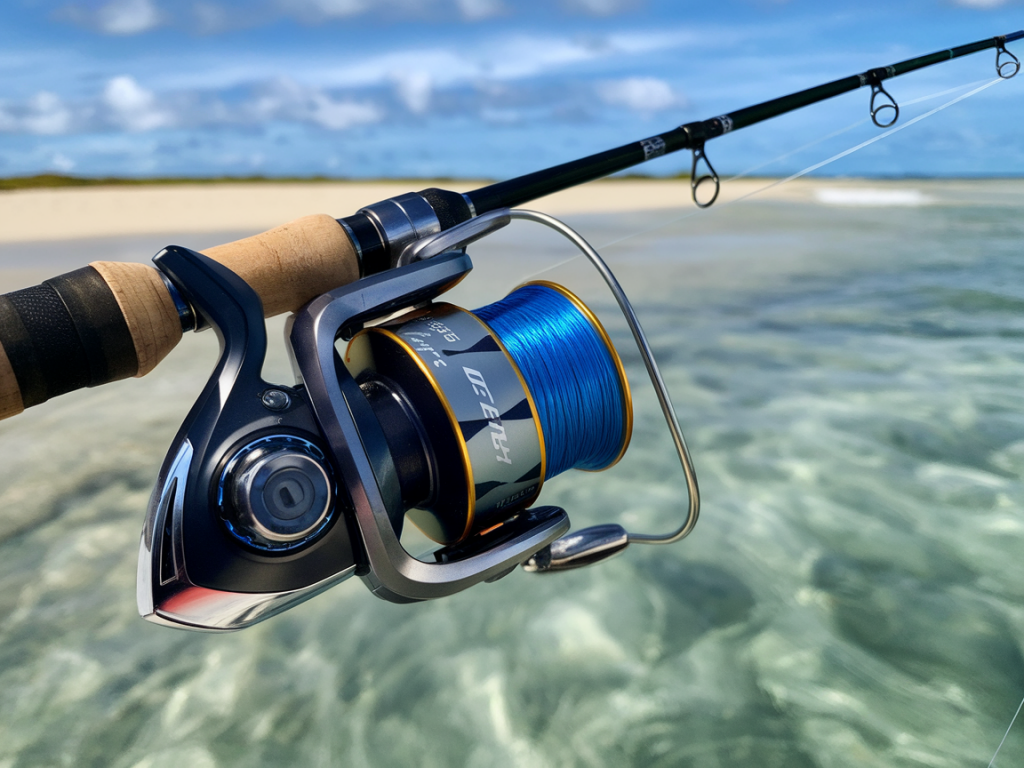
I’d been battling Southerndown’s long, wide beach for years. Some days I’d put out 140–150g leads and feel like I’d sent the bait into the sea, only to reel back line that had piled up in the spool or tangled at the swivel. Other days my casts would fly true but I’d snap off on hidden rocks or lose fish at the beach break when the braid suddenly bit into a tooth or jagged shell. The day I switched to 15lb braid with a 20lb fluorocarbon leader everything changed — my casts went further, my landing rate improved and I stopped loosing rigs on almost every other session.
Why I changed my setup
Southerndown is deceptive. From the car park it looks like a forgiving expanse of sand, but the shore is littered with weedy patches, sporadic reef and shell beds. Add often-blustery crosswinds and a knack for long runs from bass and cod, and you quickly learn that line choice matters. For a long time I trusted thin, high-test braid (20–30lb) because it “casts miles” and has zero stretch. But on this beach I was running into two problems:
After several lost fish and shredded leaders I decided to try a simpler approach: dial the mainline back to 15lb braid and pair it with a fairly stout 20lb fluorocarbon leader. The idea was to keep the casting advantages of braid but add abrasion resistance, invisibility in water and a little shock absorption via the fluoro leader.
The physics that helped my casting
This is often overlooked: casting performance isn’t just about line breaking strain — it’s about line diameter, wind resistance, spool filling and energy transfer from rod to plug or lead. Thicker braid does resist abrasion better, but it also changes how line lays on the spool and how it slices air during a cast. On my reels, swapping from a bulky 30lb braid to a more slender 15lb braid did a few helpful things:
Pairing that 15lb braid with a 20lb fluorocarbon leader meant the leader bore the brunt of abrasion and impact. Fluorocarbon has a higher density and greater resistance to abrasion than nylon or braid. It sinks faster too, which helps rigs sit how you want on the bottom during long-range beach casting.
How I rigged it (knots, lengths and sinkers)
My standard long-range beach rig for Southerndown now looks like this — kept deliberately simple and easy to tie on the bank:
| Mainline | 15lb PE braid (0.14–0.18mm, depending on reel) |
| Connection knot | FG knot or a strong Uni-to-Uni (double uni) — both are slim and pass guides smoothly |
| Leader | 20lb fluorocarbon, 3–4 metres |
| Swivel | Quality coastal swivel, size 4–6 depending on trace setup |
| Trace | 20–30lb mono or fluoro short trace (30–60cm) for abrasion and shock breaking at the hook |
| Hook | Size 1–2/0 to 4/0 depending on target species (strong, short-shank hooks for bass/cod) |
| Sinker | 120–160g long-distance bank leads, or an inline slider with a bead to prevent slip |
Notes on knots: if I’m using braid to fluoro, the FG knot gives the slimmest profile through the rings and is my preference for casting far. If you don’t feel confident tying the FG on the beach, a double uni between braid and fluoro works well — just make sure both halves are snug and trimmed tidy. If you’re using a swivel, use a good knot (Palomar or improved clinch) to tie the trace to the swivel and a secure attach for the leader to swivel.
Casting technique and reel setup
Changing the lines helped, but technique still matters. For long-range casts I do the following:
On the reel I back off drag to a level where the spool can give on a big hit without creating loose coil slack. I also keep a short backing of mono under the braid on the spool (a few metres) if I’m worried about braid slipping on certain older reel spools — but most modern reels grab braid reliably.
Why 20lb fluoro and not heavier or lighter?
Why not 30lb leader? Why not 12lb? Here's how I judged it:
20lb fluoro acts as a sacrificial, abrasion-resistant buffer at those long ranges. When a bass charges into a mussel bed or a dogfish snaps at your trace, that leader is much more likely to survive than thin braid alone.
Real results from the bank
What changed practically? On Southerndown I started to notice:
Once, during a windy evening tide, I hooked a hefty bass that screamed off 30 metres and down the beach. The drag sang, the rod doubled and for the first time in a long battle I didn’t fear the braid digging into a rock. The 20lb fluoro held and eventually the fish tired; I landed her without losing a single link in the system.
Practical tips before you try it
Switching to 15lb braid with a 20lb fluorocarbon leader hasn’t made every session perfect, but it fixed a lot of the persistent problems I had with long-range beach casting at Southerndown. It’s a simple, adaptable setup that improves casting, increases survivability of rigs and gives you a little more confidence when those long runs start.